
Central nervous system (CNS) tumors are the most common solid tumors in children and are a major cause of childhood cancer mortality. Surgery, radiotherapy and systemic therapy remain central to treatment, but radiation exposure to a developing brain and body can produce lasting effects. Proton therapy may reduce unnecessary dose to healthy tissue in selected patients. That physical advantage is important, yet it does not assure better outcomes or an absence of side effects.
Why proton therapy is considered for children
Conventional photon beams deposit dose before, within and beyond a tumor. Proton beams release most of their energy near a planned depth—the Bragg peak—and have little exit dose. A carefully optimized proton plan can therefore reduce the integral dose received by normal brain, endocrine structures, cochleae, heart, lungs, bowel, bone and other tissues, depending on the target.
For a child who may live for decades after treatment, lowering avoidable exposure can be especially valuable. Potential goals include reducing risks to growth, endocrine function, hearing, cognition and other organs, as well as reducing the radiation bath associated with second malignancies. The actual benefit depends on diagnosis, tumor location, treatment field, age, prior therapy, anatomy and plan quality. Proton therapy is an important option for selected patients, but it is not the default choice for every pediatric CNS tumor.
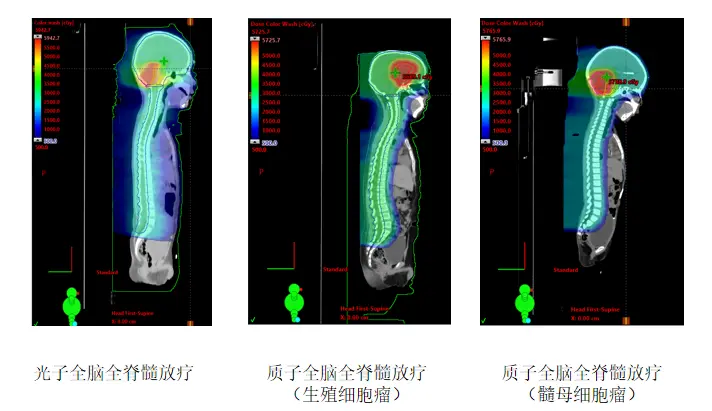
Craniospinal irradiation makes the difference easy to visualize because the target extends through the brain and spinal canal. A proton plan can often reduce dose in front of the spine and beyond the target. But this graphic is illustrative: every family should ask to see the child’s own comparative treatment plans and dose-volume histograms.
Three hospital-reported cases from Guangzhou
The following cases were described by the treating center or in Chinese media. They are short-term clinical reports, not a controlled study, and no patient-level records were supplied for independent review. The children are identified only by age and diagnosis.
Case 1: mixed germ-cell tumor
An 11-year-old with a mixed germ-cell tumor in the suprasellar region reportedly underwent surgery and chemotherapy before receiving 30 proton-therapy fractions consisting of craniospinal irradiation plus a tumor-bed boost. The hospital reported grade 1 mild bone-marrow suppression and no other clear radiotherapy-related discomfort during treatment. At a two-month review, no recurrence or metastasis was reported. Two months is too short to assess durable disease control or late toxicity.
Case 2: recurrent and metastatic germinoma
A 14-year-old had previously received whole-ventricular irradiation with a boost and was later diagnosed with recurrent, metastatic germinoma. Because normal cranial tissues had already received radiation, the Guangzhou team developed a proton reirradiation plan. At approximately one month after treatment, the hospital reported that intracranial and spinal metastatic nodules had largely regressed and that there was no obvious acute radiation reaction. This early response does not establish long-term control or prove superiority over another plan.
Case 3: medulloblastoma in a young child
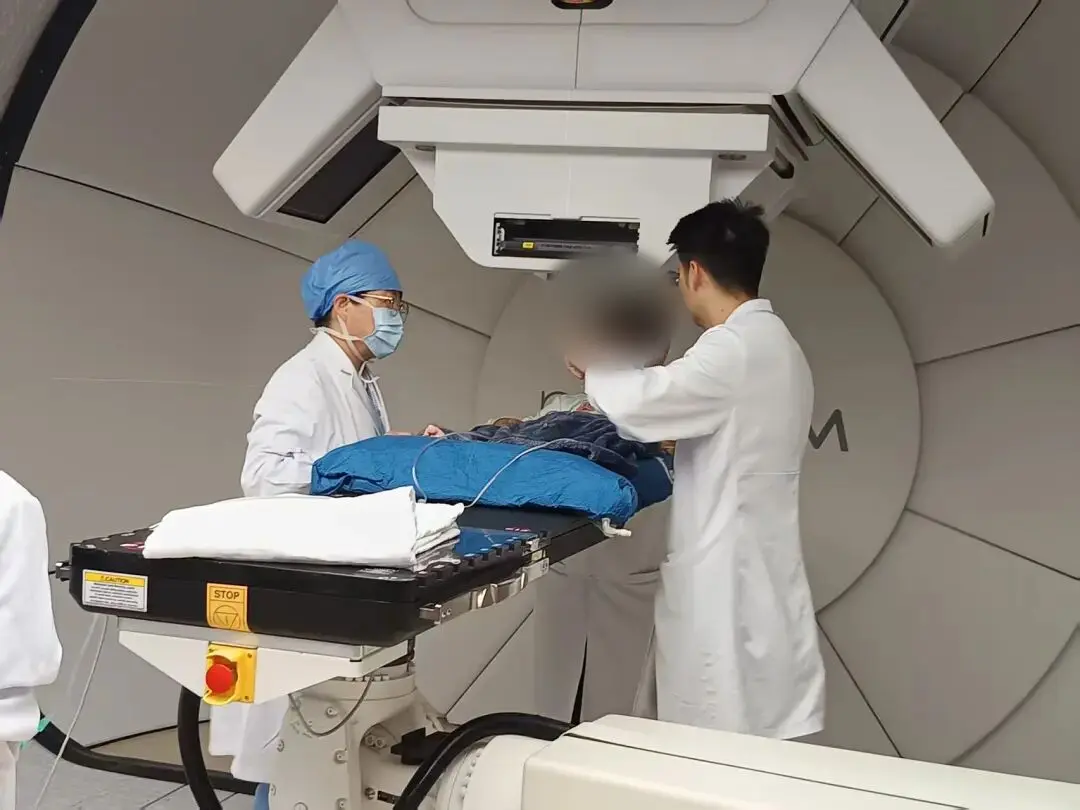
A four-year-old girl was referred after gross total resection of a medulloblastoma. Craniospinal proton therapy plus a tumor-bed boost was delivered under anesthesia because of her age. The hospital reported that she woke within minutes after each session and maintained good appetite and general condition during treatment. At three months, the report described a 4 kg weight gain, 3 cm height increase, age-appropriate intellectual development and no detected endocrine abnormality. These are encouraging short-term observations, but three months cannot establish the absence of later neurocognitive, endocrine, growth or second-cancer effects.
What the research shows—and does not show
Disease control and survival
A prospective German registry reported outcomes for 294 children treated with proton therapy for CNS tumors. Across this heterogeneous group, estimated three-year overall survival was 82.7%, progression-free survival 67.3% and local control 79.5%. These figures combine different diagnoses, risk groups and treatment approaches, so they are not a forecast for an individual child and do not, by themselves, prove that protons outperform photons.
A study presented in 2018 and later published included only 14 children aged five or younger with medulloblastoma who received focal proton irradiation to the tumor bed. Reported five-year overall survival was 84% and recurrence-free survival 70%, with wide uncertainty because the cohort was small. The result should not be generalized to all young children, all medulloblastoma risk groups or craniospinal proton treatment.
Growth, endocrine and cognitive outcomes
Reducing dose to healthy tissue provides a strong rationale for lowering some late effects. A 2023 systematic review and meta-analysis found better performance after proton therapy on several—but not all—neurocognitive measures compared with photon therapy. The authors also emphasized the need for larger studies, longer follow-up and careful control of baseline differences.
Proton therapy does not eliminate neurocognitive or endocrine risk. Tumor biology, hydrocephalus, surgery, chemotherapy, seizures, age at treatment and the dose received by specific brain regions can all affect development. Baseline and serial neuropsychological, hearing, endocrine, vision and growth assessments remain important.
Second malignancies
A lower integral dose is expected to reduce the amount of normal tissue exposed, which may reduce second-cancer risk. However, mature pediatric comparative evidence remains limited. A 2022 systematic review found pooled second-neoplasm rates of 1.5% after proton therapy and 1.8% after photon therapy; the difference was not statistically significant, and follow-up was shorter in the proton cohorts. Claims that protons have already been proven to reduce second cancers by a fixed percentage in all children overstate the evidence.
Benefits must be balanced with practical limitations
- Acute and late effects still occur. Fatigue, nausea, appetite changes, hair loss, skin reactions and bone-marrow suppression can occur, while late effects depend on the structures treated and the total treatment plan.
- Young children may need repeated anesthesia. This adds preparation, fasting, monitoring and recovery requirements.
- Proton range and biology involve uncertainty. Changes in anatomy, motion and tissue density can affect where dose is deposited, so image guidance, quality assurance and adaptive review matter.
- Access and cost vary. Travel, accommodation, treatment duration, insurance coverage and continuity of follow-up should be considered before a decision.
- The best plan may not always be proton therapy. A high-quality photon plan can be appropriate when proton access would delay urgent care, when the target is unsuitable, or when comparative planning shows little meaningful advantage.
Questions families should ask the care team
- What is the confirmed pathology, molecular subtype and risk group?
- Why is radiotherapy needed, and what are the alternatives?
- Can we review both proton and photon plans, including dose-volume histograms for critical organs?
- How will previous radiotherapy or chemotherapy change the plan?
- Will anesthesia be required, and how will it be managed?
- What short- and long-term effects are most relevant for this child?
- What is included in the written cost estimate, and what happens if the plan changes?
- Who will coordinate endocrine, hearing, cognition, growth and recurrence surveillance after treatment?
About the Guangzhou center
Guangzhou Concord Cancer Center, whose Chinese legal name is Guangzhou Taihe Cancer Hospital, operates the proton system described in the hospital reports. The center began clinical proton treatment in late 2024. Suitability, treatment capacity, timing, costs and the final radiation plan must be confirmed directly by the licensed clinical team after reviewing the child’s complete records.
Considering proton therapy in China? Chinamedtravel can help organize a confidential record review, hospital contact and practical planning. A pediatric radiation oncologist and multidisciplinary team must determine whether proton therapy is appropriate for an individual child.
Editorial disclosure: The three visuals were supplied by the customer. The treatment-room photograph has been privacy-protected; none of the images should be read as proof of a treatment outcome. The three clinical examples are attributed to the treating center and media reporting and were not independently verified from patient records.
Medical notice: This article provides general educational information, not medical advice. It does not promise eligibility, fewer complications, cure, survival or any other outcome. Decisions should be based on the child’s diagnosis, a specialist assessment and an individualized comparison of treatment plans.
References
- Yangcheng Evening News: Proton therapy included in international guidance; pediatric tumor care must consider cure and development, 29 June 2025
- National Cancer Institute: Childhood Brain and Spinal Cord Tumors Treatment Overview (PDQ)
- National Cancer Institute: Childhood Ependymoma Treatment (PDQ)—radiation and proton-therapy considerations
- National Cancer Institute: Late Effects of Treatment for Childhood Cancer (PDQ)
- ASTRO: Proton Beam Therapy Model Policy, 2026
- Cancers (Basel): KiProReg prospective registry outcomes in 294 children with CNS tumors, 2022
- International Journal of Radiation Oncology Biology Physics: Focal proton therapy in 14 very young children with medulloblastoma, 2020
- Radiotherapy and Oncology: Systematic review and meta-analysis of neurocognitive outcomes after proton versus photon therapy, 2023
- Frontiers in Oncology: Systematic review and meta-analysis of second neoplasms after pediatric proton versus photon radiotherapy, 2022
- Concord Medical Services: Official hospital network profile for Guangzhou Concord Cancer Center
This content is for educational purposes only and does not constitute medical advice. Please consult a licensed physician for health-related concerns. This website does not provide diagnosis, prescriptions or medical treatment.