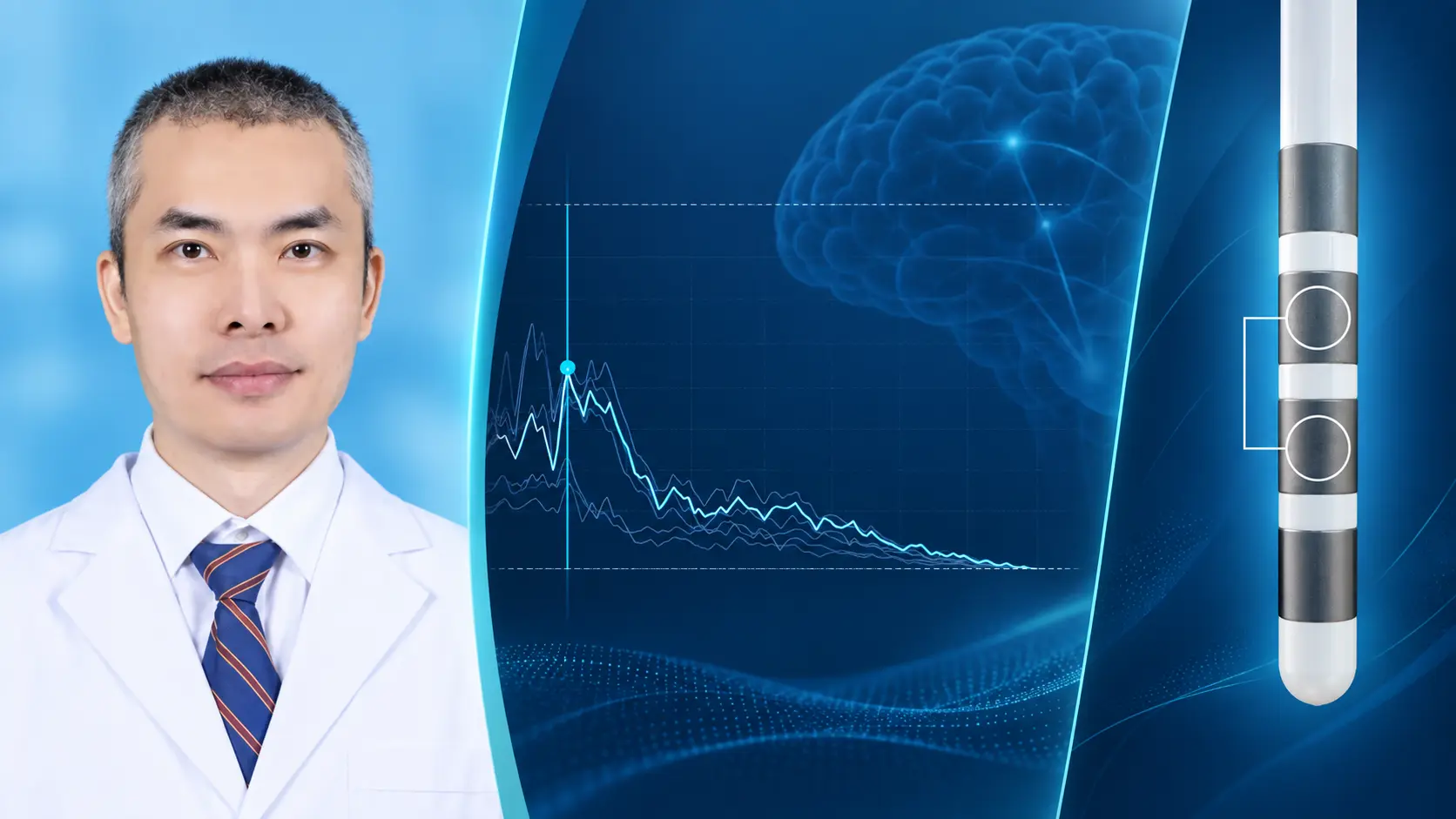
A neurosurgery team in Guangxi has reported the region’s first implantation of a rechargeable deep brain stimulation system capable of sensing local field potentials. The procedure was performed on 3 February 2026 at the First Affiliated Hospital of Sun Yat-sen University, Guangxi Hospital, for a 59-year-old patient with Parkinson’s disease. The report is an important regional clinical milestone, but it is also a single-case account—not controlled evidence of safety or effectiveness for every patient.
What the clinical team reported
According to the April 2026 interview with Dr Yang Chao and a February report in Guangxi Daily, the patient had lived with Parkinson’s disease for more than seven years. Reported symptoms included tremor, rigidity, bradykinesia, difficulty standing and initiating gait, trouble turning in bed, and constipation. Medication benefit had become less reliable.
The interview states that preoperative evaluation showed a reported 51% symptom improvement. It does not fully describe the test method or scoring conditions, so that number should not be interpreted as a complete measure of prognosis or treatment eligibility. Following multidisciplinary assessment, the team implanted a rechargeable, sensing DBS system. Postoperative imaging was reported to confirm electrode placement, and the hospital described rapid improvement in tremor and rigidity after stimulation was activated. At follow-up, the patient’s general condition and medication-related dyskinesia were also reported as improved.
These outcomes are attributed to the treating team and media reports. No patient-level source records or independent outcome assessment were supplied for this article.
The critical distinction: sensing is not the same as adaptive stimulation
The implanted system was reported to record local field potentials (LFPs)—electrical activity from deep brain structures that can be analysed alongside symptoms and stimulation settings. This sensing capability can provide clinicians with objective longitudinal information that is not available from a brief clinic examination alone.
However, automatic adaptive stimulation was not reported as active in this case. In the April interview, Dr Yang said the system’s built-in closed-loop function could be upgraded without another operation after formal approval. That wording means the case should not be described as if an approved automatic closed-loop algorithm were already adjusting stimulation in daily use.
“Brain-computer interface” is used in the source report as an umbrella term for sensing and feedback-enabled neuromodulation. Here it does not mean that the patient was controlling an external computer or that the device could read thoughts.
How LFP sensing may support DBS programming
Traditional DBS delivers stimulation using settings programmed by clinicians. Sensing-enabled systems can also record neural signals, including activity in frequency bands associated with Parkinsonian motor states. The interview reports a low-beta oscillation peak and different peak frequencies on the two implanted sides. The team used these observations as additional information when selecting contacts and individualised parameters.
LFP data can support programming, but it does not replace neurological examination, symptom diaries, medication review or patient preferences. Signal quality and clinical relevance vary between people, over time and with factors such as movement, sleep and medication. Published studies support the feasibility of biomarker-guided programming and adaptive DBS, but the 2024 blinded randomized feasibility study cited below involved only four participants and should not be treated as definitive evidence for this individual case or every device.
Why a rechargeable system may matter
For a relatively young DBS candidate, a rechargeable pulse generator may reduce the frequency of battery-replacement operations. The trade-off is an ongoing charging routine, and service life depends on stimulation settings, charging behaviour and the specific system. Device selection should consider cognition, dexterity, caregiver support, travel distance, cost and personal preference—not technology alone.
The source interview also reports conditional compatibility with 3.0-tesla whole-body MRI. MRI eligibility is device-, lead-, configuration- and condition-specific. Patients and imaging teams must verify the exact implanted components and the manufacturer’s current MR-conditional instructions before every scan; the implant does not make future imaging automatically unrestricted.
What the case does—and does not—show
- It does show that the Guangxi team reported successful implantation, LFP sensing and encouraging early clinical observations in one patient.
- It does not show comparative superiority over conventional DBS, durability over years, or a guaranteed outcome for another patient.
- It does not establish that automatic adaptive stimulation was active in this case.
- It does not identify enough registration detail in the supplied materials to independently confirm the exact device model, China registration certificate or full approved indication list.
DBS is invasive brain surgery. Potential complications can include intracranial bleeding, infection, hardware problems, stimulation-related effects, mood or cognitive changes, and the need for repeat programming or surgery. Candidate selection and informed consent require an experienced multidisciplinary team.
Regional collaboration and future plans
The hospital says it is developing a Guangdong–Guangxi neuromodulation multidisciplinary service connecting neurology, neurosurgery, neuroimaging, rehabilitation and electrophysiology. The stated aim is to expand local access to specialist assessment and follow-up. Future service availability, eligibility and regulatory status should be confirmed directly with the treating hospital.
About Dr Yang Chao
Official hospital profiles identify Dr Yang Chao as a chief physician, doctoral supervisor, vice president of the First Affiliated Hospital of Sun Yat-sen University, Guangxi Hospital, and head of its neurosurgery discipline. His listed clinical interests include Parkinson’s disease, trigeminal neuralgia, hemifacial spasm, hydrocephalus and epilepsy. The profiles also describe overseas training at the Royal Melbourne Hospital under Professor Andrew Kaye.
Considering DBS in China? Chinamedtravel can help organise a confidential case intake and hospital contact. Whether DBS, a sensing system or a rechargeable system is appropriate can be decided only after an individual assessment by a qualified movement-disorders and functional-neurosurgery team.
Editorial and commercial disclosure: The original interview states that it was co-produced by Medtronic and Neurosurgery Frontiers. Manufacturer information is therefore identified as a commercial source and was not used as independent proof of this patient’s outcome. The featured visual is an AI-enhanced editorial composite derived from the customer-supplied screenshot; its waveform and lead elements are illustrative, not raw patient data or an official device diagram.
Medical notice: This article is educational news, not medical advice. It does not recommend a specific hospital or device and does not guarantee eligibility, safety, regulatory approval or outcome. Patients should verify the exact device model, current NMPA registration and labelling, treating-team credentials, alternatives, costs and follow-up plan before making decisions.
References
- Neurosurgery Frontiers interview republished by Sohu: Guangxi’s first brain-computer-interface rechargeable and sensing DBS procedure, 17 April 2026
- Guangxi Daily: report on the 3 February 2026 implantation and 12 February discharge, 13 February 2026
- First Affiliated Hospital of Sun Yat-sen University, Guangxi Hospital: leadership profile for Dr Yang Chao
- First Affiliated Hospital of Sun Yat-sen University, Guangxi Hospital: Department of Neurosurgery
- First Affiliated Hospital of Sun Yat-sen University, Nansha Hospital: official profile for Dr Yang Chao
- Nature Medicine / PubMed: Chronic adaptive deep brain stimulation versus conventional stimulation in Parkinson’s disease: a blinded randomized feasibility trial
- Movement Disorders / PubMed: Local field potential-guided deep brain stimulation programming for Parkinson’s disease
- Medtronic: Percept RC rechargeable DBS system information for healthcare professionals (commercial source; indications and availability vary by jurisdiction)
This content is for educational purposes only and does not constitute medical advice. Please consult a licensed physician for health-related concerns. This website does not provide diagnosis, prescriptions or medical treatment.