Abstract
Since the first clinical approval in 2017, chimeric antigen receptor (CAR) T cell therapy has become one of the most powerful ways to direct the immune system against cancer. Built on decades of discovery in T cell biology and synthetic immune engineering, it has changed the treatment landscape for B cell leukaemias, lymphomas and multiple myeloma, and is now extending into autoimmune disease and solid tumours.
Gene editing, allogeneic manufacturing and in vivo delivery are improving the scalability, safety and accessibility of the approach. At the same time, antigen heterogeneity, barriers in the tumour microenvironment, cell trafficking, long-term persistence and a distinctive toxicity profile remain the key challenges that will determine clinical value in the next phase.
Introduction: reprogramming a patient’s T cells
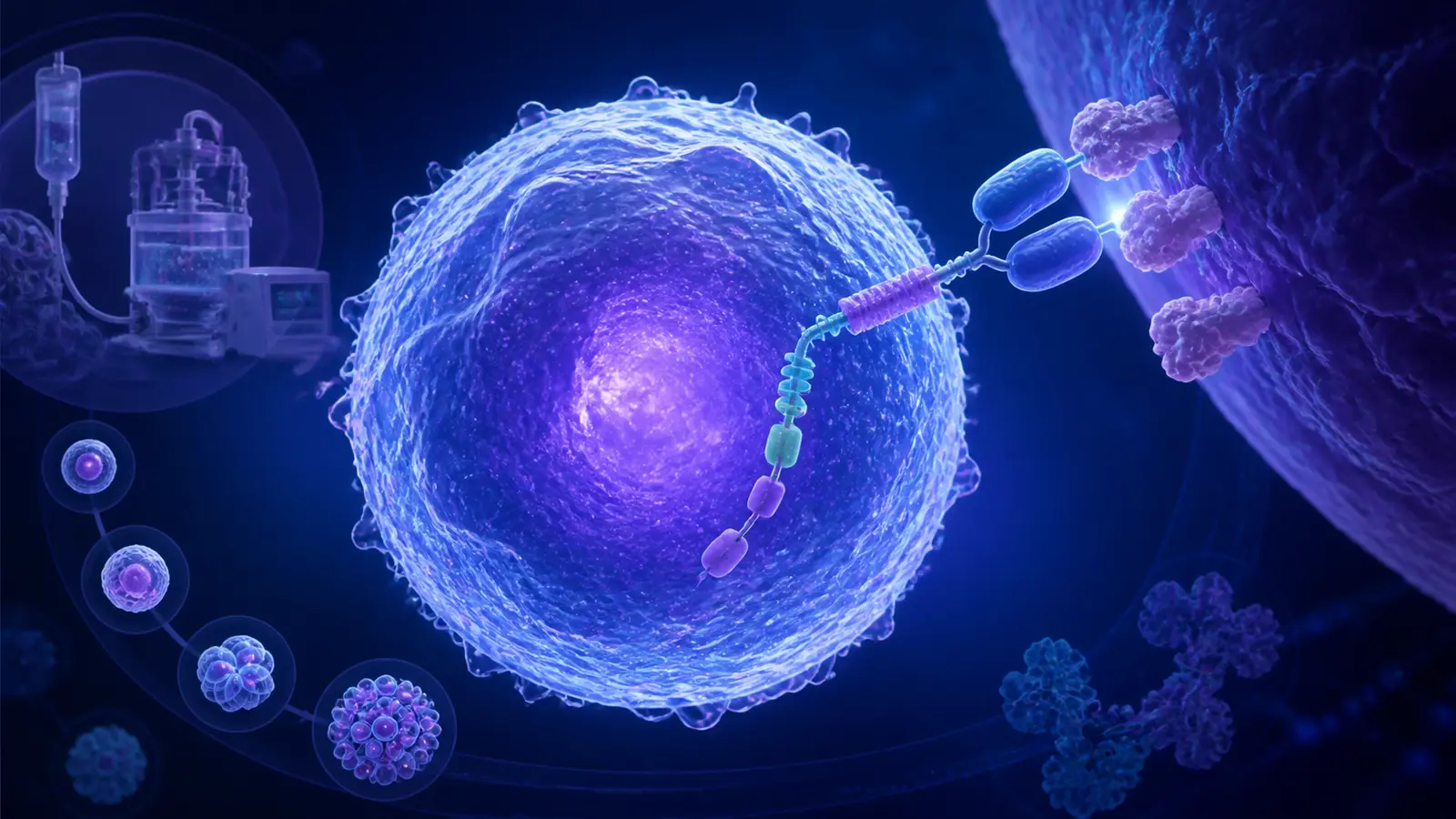
The basic principle of CAR T therapy is to genetically reprogramme a patient’s own or a donor’s T cells so that they recognise and eliminate a specific cellular target. In cancer, the target is a malignant cell expressing a tumour antigen; in autoimmune disease, it may be a pathogenic B cell or an antigen-presenting cell that drives the autoreactive response.
A conventional T cell receptor (TCR) depends on antigen presented by the major histocompatibility complex (MHC). A CAR combines an antibody-derived recognition domain with T cell signalling domains, allowing the engineered cell to bypass MHC restriction and trigger cytotoxicity with a predefined antigen specificity. That shift moved adoptive immunotherapy from “finding naturally reactive cells” to “programming living cell drugs against a chosen target”.
Why the foundational discoveries matter
From the confirmation in the 1960s that T cells are thymus-derived lymphocytes, through the discovery of CD4/CD8 subsets, MHC restriction, the TCR–CD3 complex, co-stimulatory pathways and immune checkpoints, researchers gradually mapped the signalling logic behind T cell recognition, activation, memory and tolerance. The CAR was not a single invention but the point at which that basic research was integrated into an engineerable receptor.
From the first generation to the next
First generation: proving that specificity can be redirected
During the 1980s and 1990s, researchers fused intracellular signalling domains such as CD3ζ to antibody-derived single-chain variable fragments (scFv). An scFv links the antibody heavy- and light-chain variable regions through a flexible linker into a single polypeptide, so one transgene can perform both antigen recognition and signal initiation. These receptors were first called “T-bodies” and later became the first-generation CAR.
First-generation designs proved that T cells could be directed to a predefined antigen without MHC dependence, but CD3ζ signalling alone was often insufficient to support adequate proliferation, survival and durable antitumour activity.
Second generation: adding one co-stimulatory signal
Second-generation CARs add a co-stimulatory domain such as CD28 or 4-1BB alongside CD3ζ. CD28 tends to produce faster, stronger activation and cytokine release, while 4-1BB favours more gradual activation, oxidative metabolism, central memory differentiation and long-term persistence. The core architecture of several currently approved products comes from these two routes.
Third generation: combining two co-stimulatory domains
Third-generation CARs often combine CD28 with 4-1BB, aiming to increase potency and persistence at the same time. Although some preclinical models showed strong antitumour activity, clinical benefit has been inconsistent, and the risk of excessive signalling, cytokine toxicity and premature exhaustion has kept adoption behind the second generation.
Fourth generation: armoured CAR T cells and inducible cytokines
Fourth-generation CAR T cells (also called armoured CAR T cells or TRUCKs) modify the tumour microenvironment through activation-dependent cytokine release, supporting expansion, persistence and local immune cooperation. They are of particular interest for overcoming hypoxia, nutrient deprivation and immune suppression in solid tumours.
Fifth generation and beyond: logic gates, controllable circuits and non-canonical signalling
Next-generation platforms integrate synthetic receptors, logic gating, circuit-based transcriptional programmes, inducible switches and non-canonical cytokine signalling. The goal is not simply “stronger” cells, but cells that behave correctly at the right time, in the right tissue and against the right combination of antigens — and that can be switched off or removed when risk rises.
Early clinical trials and regulatory milestones
Early human studies of CAR T cells were not limited to cancer. In the 1990s, CD4–CD3ζ engineered T cells were used in HIV research, showing that engineered cells can persist long term and traffic to relevant tissues. Early solid-tumour trials exposed the harder problems: on-target, off-tumour toxicity against normal tissue, poor persistence and insufficient infiltration.
The real breakthrough came with CD19, which is broadly expressed across B cell development and in many B cell malignancies. Using CD28–CD3ζ or 4-1BB–CD3ζ architectures, several groups observed marked expansion, deep remissions and multi-year persistence in chronic lymphocytic leukaemia, B cell acute lymphoblastic leukaemia and lymphoma.
In 2012, Emily Whitehead, a child with relapsed/refractory B-ALL, received CD19 CAR T cells, developed severe cytokine release syndrome (CRS), was treated with tocilizumab and went on to a durable remission lasting more than a decade. In August 2017, tisagenlecleucel became the first CAR T product approved by the FDA, marking the entry of engineered T cells into routine clinical practice.
Clinical success: haematological cancers and autoimmune disease
Haematological malignancies
As of April 2026, seven autologous products targeting CD19 or B cell maturation antigen (BCMA) had been approved in major regulatory markets, covering several B cell lymphomas, leukaemias and multiple myeloma. Long-term follow-up shows that a subset of patients achieve multi-year relapse-free survival, suggesting that CAR T cells can not only induce remission in refractory disease but may also deliver functional cure in selected populations.
Factors associated with durable remission include lower baseline tumour burden, a deep initial response, absence of extramedullary or extranodal involvement, strong in vivo expansion of the CAR T cells and appropriate lymphodepleting conditioning. These factors are a reminder that timing and patient condition may matter as much as receptor design.
Autoimmune disease: from depleting pathogenic B cells to “immune reset”
Because CD19- and BCMA-directed CAR T cells produce deep B cell or plasma cell depletion, they have been explored in refractory systemic lupus erythematosus, systemic sclerosis, myasthenia gravis, multiple sclerosis and antisynthetase syndrome. Early cases and small cohorts report marked improvement in several patients without continued immunosuppressive therapy.
One important observation is that durable remission does not necessarily require long-term persistence of the CAR T cells. In some patients B cells return after several months while the disease stays in remission, suggesting that a short period of deep depletion can allow the B cell repertoire to re-establish in a less pathogenic, “reset” state. This also makes short-lived allogeneic or in vivo mRNA CAR platforms particularly attractive in autoimmune disease.
Disease settings still to be solved
Acute myeloid leukaemia (AML)
The core difficulty in AML is that targetable antigens overlap heavily between leukaemic cells and healthy haematopoietic cells, and expression is heterogeneous. Early trials of CD33, CD123 and CLEC12A produced modest response rates and significant haematological toxicity. Recent work also suggests that the inflammatory environment created by CRS may in turn promote AML blast proliferation and accelerate CAR T cell exhaustion.
T cell malignancies
When CAR T cells target other T cells, problems include fratricide, prolonged depletion of normal T cells and product contamination. Strategies against CD7, CD5 and TRBC1 have shown clinical signals, and gene editing can simultaneously disrupt the endogenous target, the TCR or CD52 to reduce fratricide and graft-versus-host disease — but serious infection and delayed toxicity remain limiting.
Solid tumours
Obstacles in solid tumours include the scarcity of truly tumour-specific antigens, intratumoural antigen heterogeneity, poor trafficking and infiltration, hypoxia and nutrient deprivation, suppressive cytokines and immune checkpoints, and exhaustion driven by persistent stimulation.
Even so, the clinical signal is changing. Locoregionally delivered IL-13Rα2- or GD2-directed CAR T cells have produced some durable responses in high-grade glioma, and targets such as HER2, GPC3, CLDN6 and CLDN18.2 have shown early activity in different solid tumours. In particular, randomised controlled work on CLDN18.2 CAR T cells in advanced gastric or gastro-oesophageal junction cancer provides important evidence for the clinical feasibility of CAR T therapy in solid tumours.

Improving efficacy: stronger, longer-lasting, more precise cells
Potency and persistence
Researchers are tuning the transcription factors and signalling nodes that govern memory, metabolism and exhaustion. Engineering targets such as FOXO1, JUN, BATF, TOX, PRDM1, NR4A, REGNASE-1 and RASA2 can help CAR T cells stay in a less differentiated, memory-like state, resist chronic stimulation or improve metabolic fitness. Manufacturing matters too: shorter ex vivo culture, preservation of naive/stem-cell memory phenotypes, and media control of glucose, glutamine and lipid metabolism can all improve final product quality.
Cytokine and chemokine armouring with IL-7, IL-12, IL-15, IL-18, IL-21 or CCL19 aims to support expansion, persistence and local immune remodelling. Inducible expression, CAR degradation systems and “rest” strategies restore function in exhausted cells by reducing persistent tonic signalling.
Trafficking, infiltration and the immune synapse
To help CAR T cells reach solid tumours, engineered cells can express chemokine receptors such as CXCR1, CXCR2, CCR2, CX3CR1 or CXCR6. Vascular normalisation, extracellular matrix remodelling, FAP targeting, tissue-residency programmes and radiotherapy conditioning can further improve tumour entry and retention.
Antigen heterogeneity and escape
Approaches to improve recognition of low-density antigen include optimising signalling domains, lowering the activation threshold, selecting membrane-proximal epitopes, and using TCR-mimicking architectures such as STAR, HIT and TRuC. Tandem, bispecific or trispecific CARs, together with soluble adapter platforms, can broaden antigen coverage and adjust targeting dynamically.
Countering an immunosuppressive microenvironment
Hypoxia-responsive CARs restrict receptor expression to hypoxic tumour regions. Metabolic engineering, checkpoint inhibitors, tumour vaccines, oncolytic viruses, STING agonists and CD47 engineering are being combined to convert a hostile tumour ecosystem into one that supports T cell function.
Improving safety: controlling a living cell drug
CRS and immune effector cell-associated neurotoxicity syndrome (ICANS) are the characteristic acute toxicities of CAR T therapy. CRS follows rapid activation of CAR T cells and myeloid cells with release of IL-6, IL-1, IFNγ and other inflammatory mediators, and can present as fever, hypotension, hypoxia and organ dysfunction. ICANS may involve endothelial activation, blood–brain barrier disruption and neuroinflammation.
Controllable CAR systems use drug-sensitive switches, chemically induced dimerisation, split receptors, degron domains or protease regulation to modulate receptor activity. Suicide switches such as inducible caspase 9 and HSV-tk can eliminate the engineered cells in severe toxicity, but they also end the treatment irreversibly.
Boolean logic gates (AND, AND-NOT) and systems such as synNotch and LINK require a specific antigen combination before activation, while affinity tuning and pH-responsive receptors help CAR T cells distinguish high-density tumour antigen from low-level expression on normal tissue. Orthogonal cytokine receptors and tumour-restricted promoters can confine cytokine support more closely to the target tissue.
Long-term safety also involves insertional mutagenesis, genome integrity and the rare malignant transformation of engineered T cells. Large datasets suggest the transformation risk with standard autologous products is very low, but multiplex editing, transposon systems and integrating vectors still require rigorous long-term monitoring.
Widening access: allogeneic and in vivo CAR T cells
Allogeneic “off-the-shelf” platforms
Manufacturing CAR T cells from healthy donor cells for multiple patients can reduce waiting time, variability and cost. The main obstacles are graft-versus-host disease driven by the donor TCR, and clearance of the infused cells by host T cells, NK cells and humoral immunity. Editing of the TCR, HLA class I/II molecules and CD52, together with γδ T cells, virus-specific T cells, cord blood or iPSC-derived cells, is expanding the range of usable cell chassis.
More intensive lymphodepletion helps allogeneic cells expand but also increases the risk of delayed immune reconstitution and infection. As the number of edited loci grows, off-target effects, chromosomal rearrangement and large deletions must be controlled through more precise base editing, alternative nucleases and built-in safety switches.
In vivo CAR T engineering
Delivery platforms such as lipid or polymer nanoparticles, lentivirus, AAV, hybrid scaffolds and virus-like particles aim to reprogramme endogenous T cells directly inside the patient. This bypasses complex ex vivo manufacturing and may preserve more natural phenotypic adaptability, trafficking and expansion.
In vivo engineering still has to solve selective targeting, off-target transduction, vector immunogenicity, repeat dosing and genomic integration risk. mRNA platforms express transiently and are easier to control for safety but may require repeated dosing; integrating platforms are more durable but demand stricter long-term safety assurance.
Outlook: from targeted killing to programmable immune control
The next phase of CAR T therapy will be shaped by synthetic biology, systems immunology, single-cell multi-omics, spatial transcriptomics, reverse translation from the clinic and artificial intelligence. Longitudinal patient-derived data can reveal how engineered cells move between memory, effector and exhausted states across time, tissues and inflammatory pressure.
AI may help interpret large-scale perturbation screens, predict combinations of receptors and signalling scaffolds, and build “virtual CAR T” models that simulate interactions between the cell, the tumour, the stroma and the immune microenvironment. Clinical use may also move earlier — from late refractory disease to minimal residual disease and the adjuvant or neoadjuvant setting, pursuing durable immune control at lower antigen burden and with more intact immune architecture.
Key questions for the next decade
What defines a curative CAR T cell? Which transcriptional, metabolic and epigenetic programmes support long-term surveillance?
How should combinations be chosen? How does the timing of checkpoint inhibition, radiotherapy, chemotherapy, vaccines and small molecules affect efficacy and toxicity?
Can platforms become universal and switchable? Can one cell product be redirected across diseases through adapters or logic circuits?
How can cells be tracked in vivo in real time? Can PET reporter genes, barcoding and biosensors map the full life cycle?
Which diseases become the new frontier? Fibrosis, tissue repair, infection, metabolic disease and ageing-related conditions could all become settings for engineered immune cells.
A note for patients and families
CAR T therapy is highly individualised, with both risk and benefit. The response rates, disease control rates and safety data in the literature come from specific diseases, targets, study designs and patient populations, and cannot be extrapolated directly to any one person. A credible assessment starts from the pathological diagnosis, target testing, prior treatment, organ function, infection risk and current condition, and the decision rests with a qualified clinical team.

Professor Chen Tao
Attending Physician · International Medical Center
Cancer immunotherapy for solid tumours, haematological malignancies and lymphoma
Guangzhou Xinshi Hospital (Guangdong Pharmaceutical University Guangzhou Fosun Chancheng Hospital)
References
- Rafei H, Upadhyay R, Sharma P. A guide to CAR T cell therapies: development, current status and future prospects. Nature Reviews Immunology. 2026. DOI: 10.1038/s41577-026-01322-1
- FDA: Approved Cellular and Gene Therapy Products
- Lee DW, et al. ASTCT Consensus Grading for Cytokine Release Syndrome and Neurologic Toxicity Associated with Immune Effector Cells. Biology of Blood and Marrow Transplantation. 2019;25:625–638. DOI: 10.1016/j.bbmt.2018.12.758
- FDA: Boxed Warning for T-cell Malignancies Following BCMA- or CD19-Directed Autologous CAR-T Therapy, 2024
This content is for educational purposes only and does not constitute medical advice. Please consult a licensed physician for health-related concerns. This website does not provide diagnosis, prescriptions or medical treatment.